The Art of Waging Peace: A Strategic Approach to Improving Our Lives and the World by Paul K. Chappell
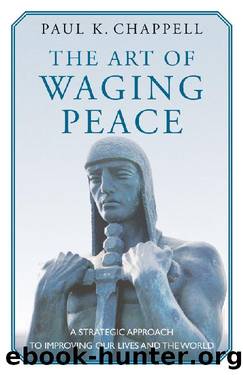
Author:Paul K. Chappell [Chappell, Paul K.]
Language: eng
Format: epub
ISBN: 9781935212683
Publisher: Easton Studio Press, LLC
Published: 2013-06-17T22:00:00+00:00
The Curse of Empire
Has there ever been a necessary war? During an interview David Pakman asked me, “[Do people ever say] Paul Chappell is clearly just a pacifist and he is against war on kind of a theoretical level, and he’s not really connected with the realities that sometimes war is necessary—so I guess my question to you is, are you against war, period?”
I replied, “There were some necessary wars in the past. And that’s why the war propaganda is so hard to refute . . . It’s hard to argue from the perspective of the Greeks that they shouldn’t have fought against the Persians when they were being invaded. It’s hard to argue from the perspective of the British that they shouldn’t have defended themselves against the Nazis. And Gandhi said if you have to choose between violence and doing nothing, you should not hesitate to use violence. And Gandhi supported Poland’s violent resistance against Nazi Germany . . . There have been wars where if you are being attacked you have to defend yourself. And that again is why the war propaganda is so persuasive, because they [war propagandists] can make every modern war seem like World War II, or they can make every modern war seem like the [American] Civil War [that claimed to be freeing the slaves], or a fight for freedom . . . But I’ve found that nonviolent techniques in this era, in the twenty-first century, are just more effective. In terms of a way of combating these problems, nonviolence is just a more effective method, or as Gandhi would call it a more powerful ‘weapon’ than violence.”29
There have certainly been justified wars of self-defense in the past, such as when ancient Athens defended itself against two Persian invasions. But after winning military victories against Persia, Athens became an aggressive empire that refused to abandon the necklace of war. Just as the Necklace of Harmonia curses its wearer with tragedy, the necklace of war led to the ruin of Athens during the Peloponnesian War, when the nations oppressed by the Athenian Empire rebelled.
In fact, every single empire in human history has collapsed, often due to military overexpansion. Thomas Cleary explains, “In the strategic science of [Sun Tzu’s] The Art of War, prolonging or expanding hostilities unnecessarily is regarded as one of the major causes of self-destruction.”30 In the ancient world, the empires of the Persians, Athenians, Spartans, Carthaginians, and Romans were ruined by extending their militaries too far. And in the twentieth century alone, the empires of Germany, Japan, and the Soviets (who invaded Afghanistan) were ruined by waging too much aggressive war. Also during the twentieth century, the European empires lost most of their colonies when the people they were oppressing rebelled in the form of nonviolent movements and violent uprisings. Martin Luther King Jr. said, “Oppressed people cannot remain oppressed forever. The yearning for freedom eventually manifests itself.”31
Unlike the British who were proud to say they were members of the British Empire, most Americans don’t like seeing our country as an empire.
Download
This site does not store any files on its server. We only index and link to content provided by other sites. Please contact the content providers to delete copyright contents if any and email us, we'll remove relevant links or contents immediately.
| Anthropology | Archaeology |
| Philosophy | Politics & Government |
| Social Sciences | Sociology |
| Women's Studies |
The Secret History by Donna Tartt(19466)
The Social Justice Warrior Handbook by Lisa De Pasquale(12292)
Thirteen Reasons Why by Jay Asher(9115)
This Is How You Lose Her by Junot Diaz(7054)
Weapons of Math Destruction by Cathy O'Neil(6465)
Zero to One by Peter Thiel(5945)
Beartown by Fredrik Backman(5930)
The Myth of the Strong Leader by Archie Brown(5623)
The Fire Next Time by James Baldwin(5579)
How Democracies Die by Steven Levitsky & Daniel Ziblatt(5321)
Promise Me, Dad by Joe Biden(5228)
Stone's Rules by Roger Stone(5185)
A Higher Loyalty: Truth, Lies, and Leadership by James Comey(5082)
100 Deadly Skills by Clint Emerson(5023)
Rise and Kill First by Ronen Bergman(4890)
Secrecy World by Jake Bernstein(4872)
The David Icke Guide to the Global Conspiracy (and how to end it) by David Icke(4845)
The Doomsday Machine by Daniel Ellsberg(4618)
The Farm by Tom Rob Smith(4608)
